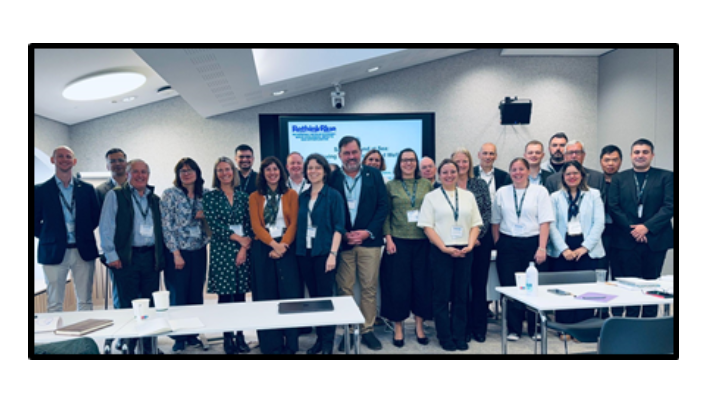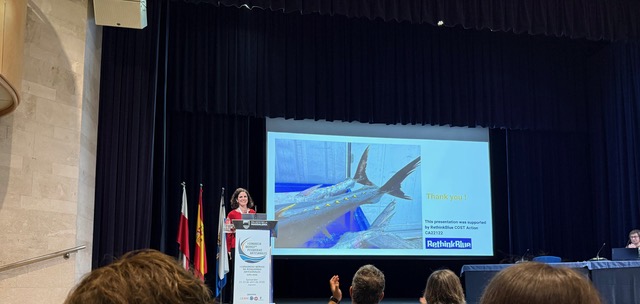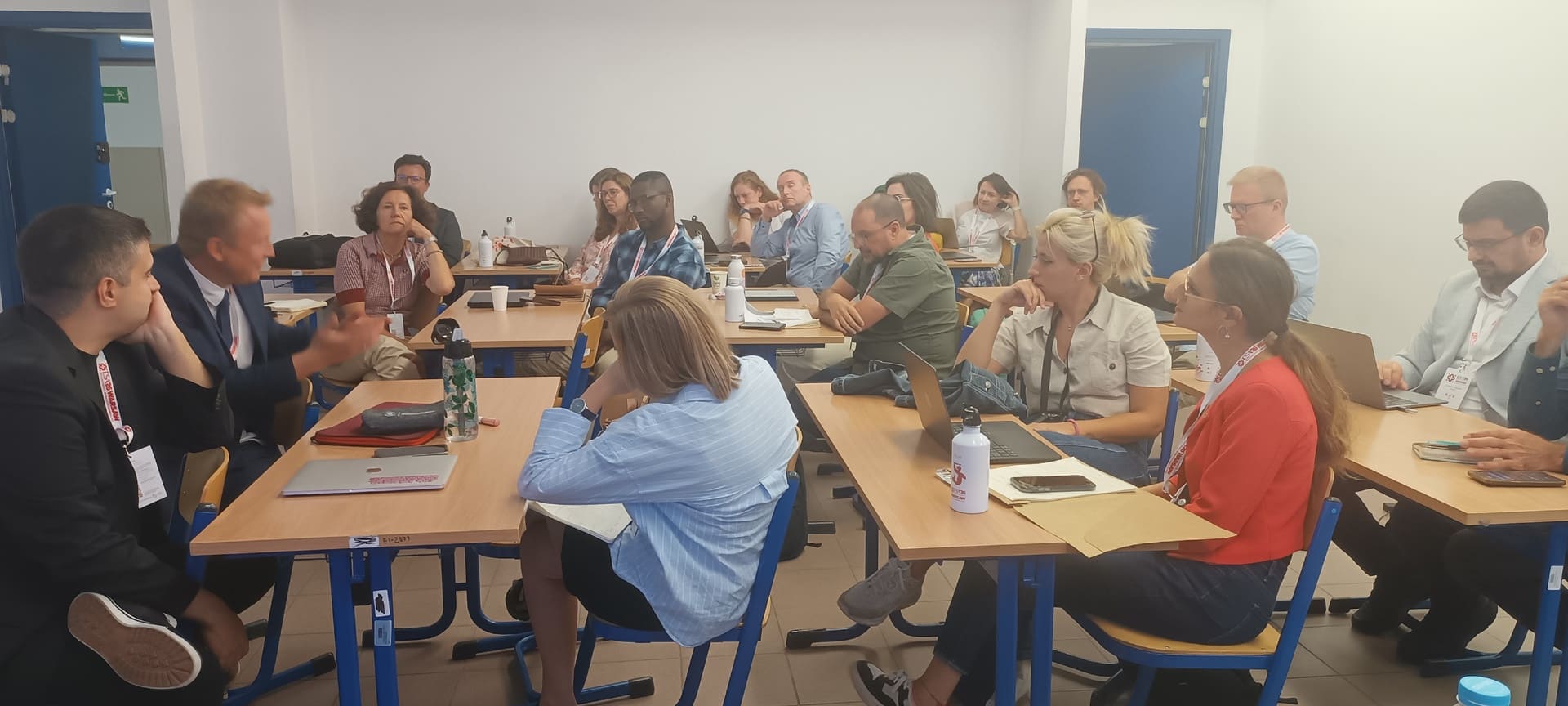
The RS14 Maritime Sociology Research Stream convened four well-attended parallel sessions at the 17th Conference of the European Sociological Association (ESA), held in Warsaw on 25–28 August 2026 under the theme “Strengthening Democracies: Social Action, Solidarity, and Sustainable Futures”.
Debates confirmed the interdisciplinary vitality of the field, and most papers comprised members of the COST Action RethinkBlue (CA22122 Rethinking the Blue Economy:
Socio-Ecological Impacts and Opportunities).
Helena Martinez-Cabrera, one of the coordinators of the sessions, said
“Challenges such as ocean grabbing, sustainability transitions and the powerful economic interests behind them not only make coastal communities more vulnerable, but also to adapt, placing them at the centre of social science attention. The sessions also opened up new questions, pointing to promising directions for future research.”
“On maritime occupations, gender equity remains far from achieved, though deviant cases where the issue appears to be one of public visibility rather than other equity dimensions, hold lessons for research-centre policy. Gendered uses of space can illuminate women seafarers’ experiences: but what can maritime sociology add to labour sociology questions like this one? With shipping struggling to attract seafarers, why do students across countries enrol in maritime programmes? Do labour expectations drive motivations, or the reverse? And in 2026, for what purpose should we address the generational renewal of fisheries social science?”
Robert Bartłomiejski, another coordinator, added
”Ocean extractivism and neighbouring fields such as the blue economy demand updated theoretical frameworks foregrounding cultural and symbolic dimensions often relegated, and recognition of the ocean as a space with agency. Clarifying links between marine, maritime and oceanic studies could foster transdisciplinarity, but could relabelling also difficult dialogue across disciplines, and what does oceanic agency imply for science and policy advice?”
“A social geography of governance also emerged from the discussions, ranging from tools for future visioning and imaginative justice, to one-size-fits-all EU emissions measures that sit uneasily with European peripheries, to effective planning that treats coasts as singular spaces. Why do social groups value some coastal activities more than others, and how should planning respond to these differences? The presentations also allowed us to look at both the beginning and the end of the Norwegian shipbuilding value chain: its prestige is mirrored by poor working conditions in its main supplier country, Turkey, sustained by capital-circulation strategies, including a substandard vessels industry governed by mafia-like structures.”
Birgit Pauksztat, co-chair of the RethinkBlue COST Action, added
“In Warsaw, a city that has rebuilt itself many times over, Maritime Sociology looks to the future. We invite those interested in the field to join the RethinkBlue COST Action. Our next international conference about the various dimensions of the Blue Economy will take place in 2027”
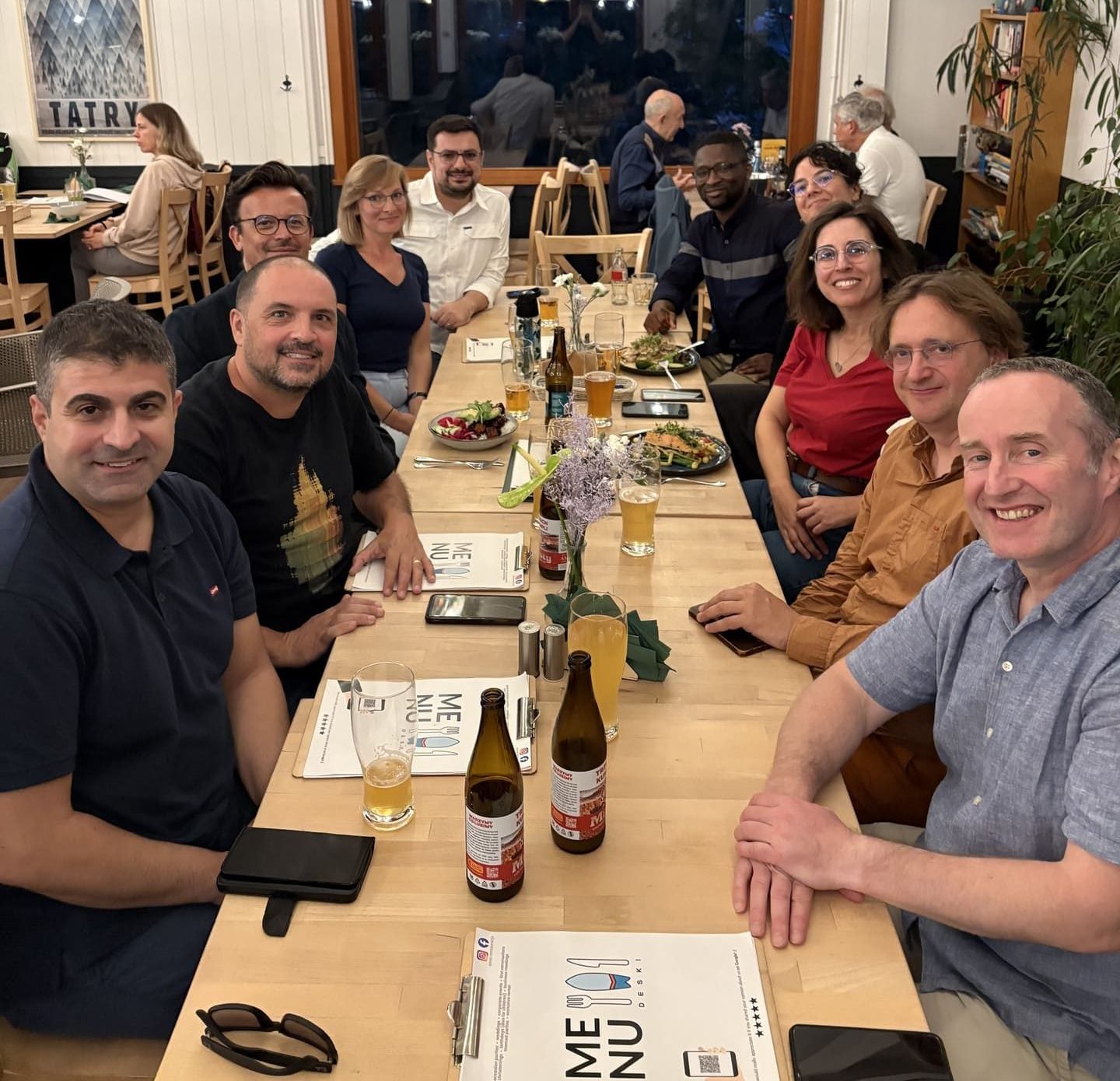
The list of papers and authors, as well as a more detailed account of the sessions, can be found below:
Research Stream RS14: Maritime Sociology
17th European Sociological Association Conference, 26–27 August 2026
List of papers:
- Motivations for Studying in a Maritime Programme — Ana Slišković (University of Zadar), Birgit Pauksztat (Nordland Research Institute / Nord University), Lijun Tang (University of Plymouth), Ioannis Katsounis (National and Kapodistrian University of Athens), Senka Šekularac-Ivošević (University of Montenegro), Helen Devereux (Southampton Solent University), Gesa Praetorius (VTI / Western Norway University of Applied Sciences)
- Qualitative Insights on Early-Career Motivations and Generational Renewal in Fisheries Social Science — Helena Martínez-Cabrera, Gonzalo Rodríguez-Rodríguez (University of Santiago de Compostela)
- Woman Are Successful in Marine Science, but Not in Its Narrative. Case Study from Poland — Paulina Pakszys, Jan Marcin Węsławski, Sławomir Sagan (Institute of Oceanology PAN), Agnieszka Skorupa (Silesian University)
Session 2 — RS14_T04: Maritime Sociology II
Thursday, 27 August 2026, 11:00–12:30 | SGGW
Chair: Helena Martínez-Cabrera
- Maritime Sociology in Times of Oceanic Turns: Revisiting the Theory of Marinization by Sustainable Blue Economy — Ioannis Katsounis (NKUA), Robert Bartłomiejski (University of Szczecin)
- Symbolic Dimension and Social Change in Small-Scale Fisheries Communities — Emanuela Diodati (RomaTre University)
- Human–Sea Relations in Transition: Cultural Values and Socio-Ecological Resilience along the Southern Baltic Coast — Lidia Stepinska-Ustasiak, Joanna Piwowarczyk, Jan Marcin Węsławski, Marcin Wichorowski, Tymon Zielinski (Institute of Oceanology PAN)
- Gender and Mobility: The Functioning of Female Seafarers in a Male-Dominated Work Environment — Colette Szczepaniak (University of Szczecin)
Session 3 — RS14_T05: Maritime Sociology III
Thursday, 27 August 2026, 14:30–16:00 | SGGW
Chair: Helena Martínez-Cabrera
- Rhetoric of Sacrifice or Sacred Ecology? Maritime Sociology in the Face of the Challenges of Blue Extractivism — Emilio Cocco (University of Teramo)
- Onboard Working Conditions on Substandard Vessels: An Ethnographic Inquiry on Seafarers of the Global South — Cagatay Edgucan Sahin (Ordu University)
- Integrated in Theory, Fragmented in Practice: Land–Sea Interactions in Portugal’s Marine Spatial Planning — Nicolás Santelices Artaza, Paulo Conceição (CITTA, University of Porto)
- Coastal Landscape Governance for a Just Blue Economy: The Portuguese Case — Carla Gonçalves, Paulo Pinho (CITTA, University of Porto)
Session 4 — RS14_T06: Maritime Sociology IV
Thursday, 27 August 2026, 16:30–18:00 | SGGW
Chair: Robert Bartłomiejski
- Making Sense of Acceptability: Considering the Social in Socio-technical Transitions — Breffni Lennon (University College Cork)
- Double Insularity and Climate Governance: Policy Stakeholders’ Perceptions of the EU Emissions Trading Scheme in Malta’s Blue Economy —Michael Briguglio (University of Malta), Therese Bajada
- Imagining the Baltic: Constructing Poland’s Energy Future at Sea — Tadeusz Józef Rudek (Jagiellonian University), Oliwia Mandrela (Jagiellonian University), Nuccio Ludovico (IREES, Groningen University)
- The Hidden Labour Enabling the Green Transition in the Norwegian Maritime Sector: Turkish Shipyard Workers — Ståle Knudsen (University of Bergen)
Maritime Sociology I: work, recruitment and the reproduction of maritime knowledge
The first session concentrated on how maritime professions and knowledge communities are recruited, sustained and publicly represented. A cross-national study of students enrolled in Maritime Education and Training programmes examined the motivations underlying the choice of a seafaring career. It identified the importance of employment security, career development, income, travel and the attraction of maritime work, while also demonstrating variation among national and institutional contexts. The session discussion highlighted the methodological value of internationally comparable instruments while cautioning against treating career motivation as independent of educational systems, labour-market conditions and national maritime traditions.
A second contribution addressed generational renewal in fisheries social science. It showed that entry into and persistence within this field are jointly shaped by intellectual commitment to fisheries and coastal questions and by opportunity structures, including mentorship, institutional traditions, precarious employment and short-term funding. The presentation also raised a wider question concerning the continuity of specialist maritime research communities and the institutional conditions necessary for their reproduction.
The final paper distinguished formal gender equality from narrative equality in marine science. Although women were shown to have reached near parity in employment, publication, fieldwork and project leadership, their expertise remained substantially less visible in mainstream media and public narratives. This distinction between participation and recognition became an important cross-cutting theme of the entire Research Stream: inclusion must be evaluated not only through numerical representation but also through authority, voice and public visibility.
Maritime Sociology II: theoretical renewal and changing human–sea relations
The second session considered how maritime sociology can respond to the contemporary oceanic turn. The opening contribution revisited Ludwik Janiszewski’s theory of marinization and proposed a renewed analytical distinction among marine, maritime and oceanic dimensions. This framework sought to connect the biophysical agency of seas and oceans, human institutions and practices, and the planetary and transboundary dynamics of the Sustainable Blue Economy.
The following papers examined symbolic resistance among small-scale fishing communities affected by ocean grabbing; the relationship between cultural values, socio-ecological resilience and Ocean Literacy along the southern Baltic coast; and the functioning of female seafarers within the material and organizational environment of the ship. Particularly significant was the treatment of vessels, equipment, medical provision, protective clothing and spatial arrangements as active components of gendered working conditions rather than as neutral objects.
Together, the contributions demonstrated that maritime sociology must connect classical concerns with occupations, communities and institutions to newer debates concerning more-than-human agency, materiality, socio-ecological systems and the politics of the Blue Economy. The discussion also showed the need to clarify the relationships between the terms marine, maritime and oceanic without isolating them into separate disciplinary domains.
Maritime Sociology III: extractivism, labour and land–sea governance
The third session placed power, exploitation and justice at the centre of maritime analysis. The first presentation contrasted the rhetoric of sacrifice accompanying blue extractivism with sacred ecology, relational understandings of the sea and practices of blue justice. It questioned policy narratives that protect selected ocean spaces while normalizing extraction and ecological sacrifice elsewhere.
An ethnographic study of seafarers working aboard substandard vessels then exposed the consequences of cost minimization for safety, accommodation, employment security and everyday life at sea. The ship emerged as both a transnational workplace and a highly unequal social environment whose regulatory protection depends heavily on vessel condition, company practices, contractual arrangements and the effective enforcement of international standards.
Two Portuguese contributions examined the persistent fragmentation of land–sea governance. One identified the institutional and regulatory difficulties of incorporating land–sea interactions into Marine Spatial Planning. The other proposed coastal landscape governance as a means of reconnecting terrestrial and marine policy, ecological processes, cultural values, public participation and spatial justice.
The session demonstrated that apparently separate questions—extractivism, seafarers’ working conditions, spatial planning and coastal landscapes—share a common sociological problem: integration may be affirmed in policy while responsibilities, knowledge and decision-making remain institutionally fragmented. A just Blue Economy consequently requires attention to the material distribution of benefits, risks, access and political voice.
Maritime Sociology IV: socio-technical transitions and unequal maritime geographies
The final session examined energy and climate transitions as socially situated and territorially uneven processes. The opening paper distinguished individual acceptance from the broader social acceptability of socio-technical change. Through an Irish coastal case, it showed that technically feasible projects may generate conflict when place attachment, competing development trajectories, community relations and opportunities for meaningful participation are neglected. The presentation emphasized that acceptability cannot be produced through one-way communication alone; it requires responsive participation, institutional learning and sustained engagement with place-based concerns.
A study of Malta introduced the concept of double insularity to explain how island dependency and European peripherality shape stakeholder interpretations of the EU Emissions Trading Scheme. Questions of competitiveness, regulatory capacity, carbon leakage and relations with non-EU Mediterranean states demonstrated the limits of applying uniform climate instruments to structurally different territories.
The Baltic Sea was subsequently analysed as a site where energy policy, geopolitical anxiety, modernization and environmental risk are assembled through competing sociotechnical imaginaries. The analysis showed that policy and public discourse make some risks and futures visible while marginalizing alternatives. The final contribution traced the hidden labour of migrant and subcontracted workers in Turkish shipyards producing vessels for Norway’s green maritime transition. It demonstrated how celebrated technological advances may depend on geographically displaced labour risks, insecure employment and limited trade-union protection.
Collective conclusions and future agenda
First, the ocean and the sea cannot be treated only as passive settings. They are relational social spaces constituted through interactions among environments, infrastructures, institutions, technologies, workers and coastal communities.
Second, blue and green transitions are distributive processes. Sociological analysis must ask who defines the transition, who participates, who benefits, who bears its costs and where those costs become visible or remain hidden.
Third, recognition is as important as formal participation. Women scientists, female seafarers, migrant shipyard workers, precarious researchers, small-scale fishers and peripheral communities contribute fundamentally to maritime systems but remain weakly represented in dominant institutional and public narratives.
Fourth, land–sea relations require genuinely integrated analysis. Administrative boundaries between terrestrial and marine governance frequently obscure the social, ecological and economic continuities through which coastal and maritime transformations occur.
Fifth, the sessions demonstrated the value of methodological pluralism. Cross-national surveys, bibliometric analysis, interviews, ethnography, participant observation, policy analysis and computational discourse analysis provided complementary ways of examining maritime social worlds.
The Research Stream therefore identified a clear future agenda: stronger comparative and longitudinal research; closer integration of labour, gender, environmental justice and governance perspectives; systematic attention to peripheral and non-metropolitan maritime regions; and further conceptual work linking established maritime sociology with the oceanic turn, socio-material analysis and more-than-human approaches. It also confirmed the need to consolidate an enduring European and international network through which maritime sociologists can share data, methods, concepts and comparative research initiatives.